Saturday, October 15, 2011

Secure at Home

We always feel completely secure in our Temple Block both working and living.  The entire property is enclosed in a nice fence and the gates are closed/locked during the night.  There is a guardhouse and a security company has it staffed 24/7.  The guards are often walking around checking on things.
You can see in the left of the photo a pole with video cameras on it.  They are located around and on the property, covering all of the area.  During last year the contractors had out the blueprints of the security system in the basement where our exercise equipment is and were changing some of the cameras for better coverage.  Note the camera array in the next picture.
Also on our temple block is a building to house the water system including filtration (at two levels--for regular use and purer for drinking only) and heating water for both culinary use and for heating the buildings' radiators during cold weather.  In the foreground behind the landscaped wall is a filtration area.
In the far right of the previous photo is the other building, housing the electrical systems.  To the left is a shed for some of the equipment.  This shows it from both sides.  Again note security camera poles in the second photo.
Here is a low area designed as a catch basin for the rain water.  The ground cover there is not regular grass, but "meadow grass and wildflowers"but this photo was taken in February after some snow had melted.
This is an "island" in the intersection coming off the "ring road" to the road into the temple property.  It was naturally covered with grass and weeds.  The temple president thought it ought to be better kept and so it was tilled, and planted with flowers from seed.  Here is the beautiful result:
As you can see, it was a stormy October day when the photos were taken so the sky is dramatic.  The leaves are changing and everything is beautiful--another reason we love living here!

Wednesday, September 14, 2011

Wooden Churches Covered with Metal

I have already posted pictures of lovely churches built of wood which we saw in the Carpathians.  Of course, wood was the available building material.  As I researched, I found that wooden churches are typical in villages all over.  
In some areas we found that these structures had been overlaid with metal and were very beautiful.  Wikipedia reports: "Unique to Hutsul churches is the use of tin or metalwork in the upper parts of the church, which are also used in home architecture of the region".
This particular church in Pistyn from 1600 was said to be beautiful as a wooden structure.  One writer regretted it had been covered with metal.  I found the result very stunning.
I loved the details in embossing various metal panels, the multi-layers and the intricate cut/stamp work
This little building shows such details
One article said that domes, in particular onion-shaped ones, began to be constructed after the Mongol invasion.  They are good for helping snow slide off!  Of course, they have become the signature of Orthodox churches.  

Tuesday, September 13, 2011

Transcarpathian Ukraine--between Kyiv, Budapest and Vienna

The western area of Ukraine has often been part of European countries such as Lithuania, Poland, Austria, and Hungary.  In central Chernivtsi we saw many old buildings that looked European.  Most of them were built after Chernivtsi became part of the Austrain empire in 1850 so this city is often called "Little Vienna"
This is the city hall and square.  The most impressive building complex was the former residence of the Orthodox Metropolitans which now house the central buildings of the university.  We happened to be there on Aug 31, not knowing that this was the day to officially welcome all new students who would be starting school the next day.  We were lucky to find a parking place and found the grounds swarming with new students, often with their parents.  The balcony of the central building was used as the speakers' platform as several officials in their academic robes gave speeches.  An orchestra and chorus  on ground level provided music.  We skirted the crowds and took pictures.
Because this area often changed hands politically, various church allegiances developed.  Europeans brought Catholic Christianity and constructed many Catholic churches.  In 1646 a council in Uzhhorod, after lengthy negotiations, declared a unity between the orthodox and catholic churches in transcarpathia.    This Greek-Catholic Cathedral in Uzhhorod dates to that time. 
This is the Trinitarian Cathedral in Kamianets-Podilskyi
A former Jesuit Cathedral, this is now the Archcathedral of the Resurrection in Ivano-Frankivsk
 The Armenian Church in Ivano-Frankivsk
The protestant Reformation also brought Lutheran and other protestant churches to the region.

Friday, September 9, 2011

Pysanky--Ukrainian Eggs

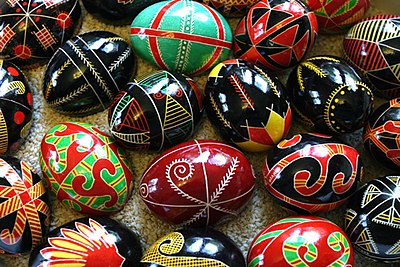
The following info was collected from Wikipedia and may be more than you wanted to know!: The word pysanka refers specifically to an egg decorated with traditional Ukrainian folk designs, and is not a generic term for any egg decorated using "wax resist". The art of the decorated egg in Ukraine, or the pysanka, probably dates back to ancient times. With the advent of Christianity in Ukraine in 988 the symbolism of the egg was changed to represent, not nature's rebirth, but the rebirth of man. The decorated pysanka, in time, was adapted to play an important role in Ukrainian rituals of the new religion. In modern times, the art of the pysanka was carried abroad by Ukrainian emigrants to North and South America, where the custom took hold, and concurrently banished in Ukraine by the Soviet regime (as a religious practice), where it was nearly forgotten. Museum collections were destroyed both by war and by Soviet cadres. Since Ukrainian Independence in 1991, there has been a rebirth of the art in its homeland.The Hutsuls––Ukrainians who live in the Carpathian Mountains of western Ukraine––believe that the fate of the world depends upon the pysanka. As long as the egg decorating custom continues, the world will exist. Pysanky were traditionally made during the last week of Lent, Holy Week in the Orthodox and Greek (Uniate) Catholic calendars. (Both faiths are represented in Ukraine, and both still celebrate Easter by the Julian calendar.) They were made by the women of the family. 
We went to this museum in Kolomyia which opened in 2000.  We were not allowed to take photographs inside.  This picture came from Wikipedia:

When we were in the Hutsal museum nearby, we were invited to come into the pysanky conservation room where a nice English-speaking assistant gave us a personal explanation of how these eggs are decorated.
She explained that the first step is to apply a beeswax design to the white shell of a raw egg with a stylus (she has one in her hand and the warming pot of wax in the extreme left of the photo).  In Transcarpathia, a simple pin inserted onto the end of a stick was used.  This is a picture of various styluses and the explanation of the process taken from Wikipedia: 
The molten wax was applied to the white egg shell with a writing motion; any bit of shell covered with wax would be sealed, and remain white. Then the egg was dyed yellow, and more wax applied, and then orange, red, purple, black. (The dye sequence was always light to dark). Bits of shell covered with wax remained that color. After the final color, usually red, brown or black, the wax was removed by heating the egg over the stove and gently wiping off the melted wax, or by briefly dipping the egg into boiling water.

In this room. a woman developed the process of conserving the raw eggs.  If the eggs were new, they could be blown empty, but that is not the best way to save them because they are very fragile.  Whether the eggs are old or not, it is best to gently crack them open and remove the insides (see all of the half shells in the containers).  The membrane next to the shell must be removed too, which may be difficult.  Then small bits of paper are glued onto the inside of the shell (as she is demonstrating), concluding with some that will overlap when the two halves are put together.  When this is concluded, the little cracked area is repaired.  Now the egg shells are very strong and will last.  All of the eggs displayed in the museum pictured above had been preserved in this manner in this room!  
The most popular pysanka designs are geometric and the traditional  colors are yellow, red and brown/black.  This is another photo from Wikipedia.  We bought some wooden eggs that had been hand-painted with a stylus as souvenirs and thinking they would survive the shipment home; we also bought a couple of "real" hollow eggs and hope they will survive.

Thursday, September 8, 2011

Hutsal Folk Art

The Hutsuls are an ethno-cultural group of Ukrainian highlanders who for centuries have inhabited the Carpathian mountains, mainly in Ukraine but also the northern extremity of next-door Romania.  Hutsul society was traditionally based on forestry and logging, as well as cattle and sheep breeding.  Most of the old churches we saw were built of wood with intricate craftsmanship.  This one, in Kolomyia, was built in 1587
We visited a museum of Hutsul folk art in Kolomyia and were able to take photos of the exhibits.
These are from exhibits that show a model of another church, the wooden furniture crafted for the home, as well as their woven articles.
Their pottery usually used these green, yellow and brown tones and featured natural motifs.  This shows some of their bowls and a tiled stove/oven
They wove woolen and linen items in patterns that remind us of Western Indians.
They also did beadwork in patterns that look very Indian to us!
Their folk dress is very interesting and colorful with ornamentation.  As shepherds, wool and sheepskin was used. There is much embroidery.  These exhibits were inside glass cases and often the light from opposite windows created glares that I tried to crop out of the photo.  Notice the small long-handled hatchet at the man's side in the first photo--it is a "bartok"
This gives you a close-up of the vest and jacket that is embroidered on the outside of the sheepskin suede with the wool left on the inside for warmth.
Here you see the leather turned-up-toe style moccasin they made worn with woolen knitted stockings and leggings if necessary.   "Pysanky" or decorated eggs will be a separate blog!
Ornate dress for special occasions like weddings!