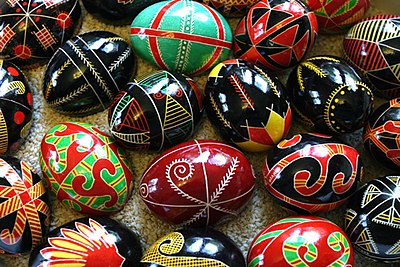
The following info was collected from Wikipedia and may be more than you wanted to know!: The word pysanka refers specifically to an egg decorated with traditional Ukrainian folk designs, and is not a generic term for any egg decorated using "wax resist". The art of the decorated egg in Ukraine, or the pysanka, probably dates back to ancient times. With the advent of Christianity in Ukraine in 988 the symbolism of the egg was changed to represent, not nature's rebirth, but the rebirth of man. The decorated pysanka, in time, was adapted to play an important role in Ukrainian rituals of the new religion. In modern times, the art of the pysanka was carried abroad by Ukrainian emigrants to North and South America, where the custom took hold, and concurrently banished in Ukraine by the Soviet regime (as a religious practice), where it was nearly forgotten. Museum collections were destroyed both by war and by Soviet cadres. Since Ukrainian Independence in 1991, there has been a rebirth of the art in its homeland.The Hutsuls––Ukrainians who live in the Carpathian Mountains of western Ukraine––believe that the fate of the world depends upon the pysanka. As long as the egg decorating custom continues, the world will exist. Pysanky were traditionally made during the last week of Lent, Holy Week in the Orthodox and Greek (Uniate) Catholic calendars. (Both faiths are represented in Ukraine, and both still celebrate Easter by the Julian calendar.) They were made by the women of the family.
We went to this museum in Kolomyia which opened in 2000. We were not allowed to take photographs inside. This picture came from Wikipedia:
 When we were in the Hutsal museum nearby, we were invited to come into the pysanky conservation room where a nice English-speaking assistant gave us a personal explanation of how these eggs are decorated.
She explained that the first step is to apply a beeswax design to the white shell of a raw egg with a stylus (she has one in her hand and the warming pot of wax in the extreme left of the photo). In Transcarpathia, a simple pin inserted onto the end of a stick was used. This is a picture of various styluses and the explanation of the process taken from Wikipedia:
When we were in the Hutsal museum nearby, we were invited to come into the pysanky conservation room where a nice English-speaking assistant gave us a personal explanation of how these eggs are decorated.
She explained that the first step is to apply a beeswax design to the white shell of a raw egg with a stylus (she has one in her hand and the warming pot of wax in the extreme left of the photo). In Transcarpathia, a simple pin inserted onto the end of a stick was used. This is a picture of various styluses and the explanation of the process taken from Wikipedia:
The molten wax was applied to the white egg shell with a writing motion; any bit of shell covered with wax would be sealed, and remain white. Then the egg was dyed yellow, and more wax applied, and then orange, red, purple, black. (The dye sequence was always light to dark). Bits of shell covered with wax remained that color. After the final color, usually red, brown or black, the wax was removed by heating the egg over the stove and gently wiping off the melted wax, or by briefly dipping the egg into boiling water. 
In this room. a woman developed the process of conserving the raw eggs. If the eggs were new, they could be blown empty, but that is not the best way to save them because they are very fragile. Whether the eggs are old or not, it is best to gently crack them open and remove the insides (see all of the half shells in the containers). The membrane next to the shell must be removed too, which may be difficult. Then small bits of paper are glued onto the inside of the shell (as she is demonstrating), concluding with some that will overlap when the two halves are put together. When this is concluded, the little cracked area is repaired. Now the egg shells are very strong and will last. All of the eggs displayed in the museum pictured above had been preserved in this manner in this room!

The most popular pysanka designs are geometric and the traditional colors are yellow, red and brown/black. This is another photo from Wikipedia. We bought some wooden eggs that had been hand-painted with a stylus as souvenirs and thinking they would survive the shipment home; we also bought a couple of "real" hollow eggs and hope they will survive.