Wednesday, April 27, 2011

Flat Stanley Visits Friends

Flat Stanley is a story written by Jeff Brown about a boy who had a bulletin board fall on him while he slept and he became 1/2 inch thick.  He has many adventures like getting mailed to California or flying like a kite.  Some elementary school teachers use this as a springboard for a project for English/Social Studies.  Each student creates a "Flat Stanley" and sends him to a person he knows.  Jayden sent his Flat Stanley to us and we enjoyed having him with us and taking him on adventures.  He arrived on April 8.  In his instructions, Jayden told us that Stanley was afraid of thunderstorms and would need a night light.  Just after he arrived, we had the first thunder and lightening storm with rain that we have had for months!  I was awakened by the storm and put Stanley by our nightlight on our bathroom counter while I enjoyed the storm!

The next day I took Flat Stan with me to the temple.  The grounds crew were planting the flower boxes with forced narcissus and pansies.


We were invited to visit Pavlina Ubyiko and Yulia Simanovskaya on a Monday afternoon, April 11.  Pavlina Ubyiko is a secretary in the temple office who speaks English and is also a temple worker.  Yulia Simanovska is another temple worker.  Both of them have children but are divorced.  They are very nice. We met and first went to a museum about the Chernobyl nuclear power plant accident. That is a place in northern Ukraine where Russia built several nuclear power plants.  On April 26, 1986 (25 years ago) one of the  plants exploded and burned, sending radioactive particles that were carried by the wind all over.  It is considered the  worst nuclear accident in history so far.  Many cities and towns nearby were evacuated and the people had to live somewhere else.  They never got to go back to their homes or apartments.  In the museum there were lots of pictures of children who had to leave their toys and clothes and go somewhere else.  


The first picture shows Pavlina and Yulia with Flat Stan at the steps going up to the exhibits with signs of cities that were ruined hanging above.  The apples pictured on the steps were reminders that no one could pick the fruit and eat it that year because it was contaminated.  


The next photo shows Flat Stan in a bush in front of a monument for those who lost their lives.  There were some older students waiting to go into the museum and one of them told me she knew a Flat Stanley from Chicago!  Though this might be boring, because of the problems with the nuclear reactor in Japan after the tsunami there, we all are more concerned about the dangers of radiation leaks from nuclear power plants.


Then we went to Pavlina's aparrtment.  This is the school among the apartment buildings where she lives.  Sis Ubiko's apartment in one of the buildings behind the school, an old building and very typical of apartments in Kyiv. 


Flat Stan is having fun with the big sign on a building and Grandpa! 


Here is a picture of Sis U welcoming us to her apartment.  They fixed a wonderful meal.  


Here is Flat Stan by some french bread that Grandma had spread with cheese spreads.  Sis U is frying some potato and cabbage dumplings.  Sis. S is standing by the salad she made.  


Then you can see on the table the yummy split pea soup and salad we ate along with the special cake they bought for our dessert.  


Flat Stan enjoyed meeting the cat, Fluffy, who is old and deaf. 


Grandpa bought the sisters some daffodils as we were leaving to go home.  We were very grateful for their hospitality.  


Tuesday, April 26, 2011

Easter-time in Ukraine


We have been learning about and experiencing Easter traditions in Ukraine.  I have included here much information and pictures I have copied from online sources too numerous to mention.   We were excited when we were passing by the Orthodox Church on our way to our own church services in Chernigov on the Sunday before Easter.  We had known that Palm Sunday was celebrated in Slavic countries with pussywillows.  Here we saw them being sold!  Members of the congregation, too numerous to all go inside, were standing outside to listen.  In the Orthodox church there are no benches; people stand for the services.


Springtime rituals were already well established by the time Prince Vladimir turned the Kievan Rus into a Christian state in 988.  Pagan Ukrainians had been welcoming spring with dancing, fires, painted eggs, and other rituals for centuries. Some of these annual practices were absorbed into Christian Easter rites but maintained their roots in the peasants’ eyes as important springtime traditions.  For example, the cutting of pussywillow branches was not originally a Christian substitute for palm branches. Since pagan times, the pussywillow’s bloom was seen as a signpost for spring and was thought to have healthful qualities if ingested. Pagan Ukrainians would cut the branches and swat one another with them to bless each other with the pussywillow’s strength to come out of winter so early in the year. When Palm Sunday began to be celebrated, the two practices merged into one.


We bought some souvenir plastic Easter eggs and hung them on some branches that we brought inside on our general conference Sunday.  The branches sprouted and it looked like this.  Though we bought these hanging eggs, Ukrainians don't use them!  They are just souvenirs that someone like me could use this way.  I thought is was fun; a Ukrainian looked at me funny when I asked them about what they would use them for.  They wouldn't buy them!

The next year we also decorated branches with our grandchildren who were visiting.  We also bought a bunch of pussy will and birch twigs at the time of Palm Sunday.  Here is a picture of them both.


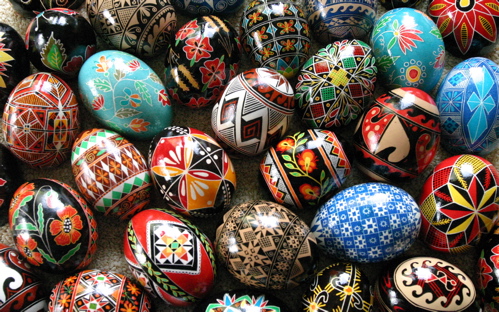
Easter eggs are an important part of the Eastern European Easter tradition. Eggs, symbols of fertility, springtime, renewal, life, good luck, eternity, and rebirth have been given as gifts and used in springtime rites for centuries in Eastern European countries so they are really holdovers from a pagan tradition.  Ukrainian Eggs (Pysanky) are famed the world over for their intricate designs, bold colors, and the skill it takes to draw precisely on a curved surface using a wax-resist method. While other Eastern European countries paint eggs for Easter, Ukraine is the most famous for this practice.  These eggs are not hard-boiled but are usually "blown out" after painting. 


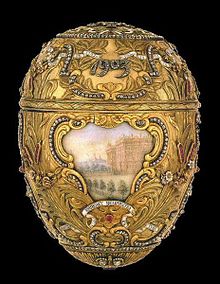
The Faberge egg tradition began in Tsarist Russia. These highly-prized and priceless art objects were the Easter eggs of royalty.   Fabergé eggs were commissioned by Czar Alexander III of Russia as an Easter surprise for his wife.  They are not Ukrainian!


On Friday we went to the store to get groceries and also wanted to get some Ukrainian Easter bread. It turns out it was precisely the right day because Friday is the day most housewives (and stores) bake this bread.  We found shelves of the fresh Easter bread available.


We bought two and started eating the smaller one.  Recipes online are of a slightly sweet yeast-rising dough with eggs and perhaps some cardamon, raisins and almonds. The top is decorated with cut dough shapes or white frosting. It tasted to me like my hot cross buns!


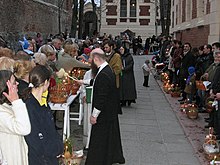
The Easter basket is prepared for Sunday morning.  It includes the Easter bread, eggs--both the pysanky decorated ones, and hard-boiled ones just dyed--usually red to represent the blood of Christ,  The hard shell can symbolize the sealed tomb of Christ so the cracking of it symbolizes Christ's resurrection from the dead.  Other foods such as cheese, butter, salt, pork fat, horse radish, ham, sausages, as well as various seeds were also brought to church for the blessing.  


We saw people on the subway Sunday morning with their Easter baskets.  I don't know if they were on their way to or from the church at that hour (8a)  When we arrived in Chernigov after 10a, there were only a few people in the area of the Orthodox church.  The church doors were open, but only lit candles were inside.  
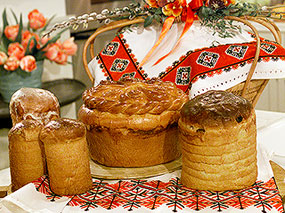

Paska by Lubow Wolynetz as seen on Martha Stewart


The Resurrection Mass in olden times a was held in the early morning before the rising of the sun. At that time in history all churches in Ukraine were built to face the East. When the Mass was ending and the priest first said "Chrystos Voskres" (Christ Has Risen).  Following the Mass the people greeted each other in the traditional way, by kissing each other three times.  Sometimes there would be a procession around the church three times.  The people would then stand outside the church with their baskets filled with the food which they had prepared for the blessing ceremony. A lit candle was always placed in the baskets which were decorated with aromatic herbs and periwinkle. Immediately after the ceremony the family would hurry home to share the blessed paska and thus begin Easter breakfast.  On our way back from Chernigov we saw many people outside enjoying a picnic on a beautiful Spring day.  I imagined they were enjoying the contents of their Easter baskets!  Most stores were closed and few people were on the streets.  It truly seemed like families were celebrating a holy day.


During the Easter season the dead are remembered on Maundy Thursday (before Easter) and also during the whole week after Easter, especially on the first Sunday following Easter Sunday.  People gather in the cemetery, bringing with them a dish containing some food and liquor or wine, which they consume, leaving the rest at the graves. This tradition is still very alive in Ukraine and cemeteries have built-in tables and benches around the tombs for this important moment.  People usually come and clean the tomb area, then celebrate with eating and drinking; they will then leave on the tomb some food and drink even unopened.  It is part of the Ukrainian tradition as well that the poor people are allowed to come later in the cemeteries late in the evening in order to retrieve the food that has been left for them intentionally.  People also can leave lit candles on graves.  There are enclosed votive-type candles that can be bought which would be safe and shielded from wind. (See stacks of these colored cylinders behind the baskets and in front of the flowers in the grocery store photo above)


This seems like a wonderful time to do the Spring cleaning of cemetery plots and then remember the overarching blessings of Easter.  During the Easter season, when you meet people you say "Christ is risen" and the reply should be "Truly risen".  That knowledge is in our hearts and central to all we are doing here in Ukraine.  All people will be resurrected and live forever.  But also because of Christ's atonement, we can be forgiven of our sins and may be helped to follow His Gospel in serving and loving those around us.  And we may prepare ourselves to live together with family members and with our Heavenly Father and His beloved Son, Jesus Christ.  

Sunday, April 3, 2011

The Bandura


The Bandura is a Ukrainian plucked string folk instrument. Hundreds of years ago it was often used by a blind minstrel as accompaniment to his singing!   Pictured is an early instrument that had 4 bass strings and 20-23 strings total.  Modern instruments have 55-65 metal strings tuned chromatically through 5 octaves, with or without retuning mechanisms (which allows for the rapid retuning of the instrument into different keys).  Below is Sis. Serduk's modern bandura with 65 strings.  You can identify the levers of the retuning mechanism on the right of the tuning pegs.  What you can't see well is the two levels of strings which helps her fingers to know by feel which to pluck.  She started to learn as a child and wasn't happy but stuck with it for a few years and then left it behind until she became an adult.  Now she is so happy to be able to play!


I first saw the bandura used in the orchestra for the cultural celebration before the dedication of the temple.  Then when I saw Sis Serdyuk play it in a Christmas concert, I asked her about it.  Katia Serdyk is a temple worker and speaks English, so I knew her and could communicate with her!  She was happy to share details with me and offered to come and help all of us temple missionaries appreciate this Ukrainian folk instrument.  She prepared for a month and put together a program of folk music that also included Ukrainian folk songs.  Her helpers were a young man we often see at the temple and a couple who recently joined the church.  The couple are professional musicians.  He's a member of the Kyiv Bandura Choir that performs concerts and also tours.  He plays an alto bass bandura and also has a wonderful singing voice.  Sis. Serkyuk is not professional, but just enjoys the instrument and sharing her talents in many ways.  Here is a clip of video I took during their presentation.


Hopefully you will be able to notice that the bass strings are plucked by her left hand while the right hand is plucking the melody, and then sometimes she is also singing!  She does use finger picks.  Here is a picture of the group.  We really enjoyed their music.


Thursday, March 17, 2011

Alphabets

Most Americans believe that learning a new alphabet is hard/impossible/unnecessary!  It is amazing to us that Ukrainians grow up learning at least 3 alphabets!  This is the Ukrainian Alphabet.  It is based on Cyrillic letters:
Ukrainian alphabet


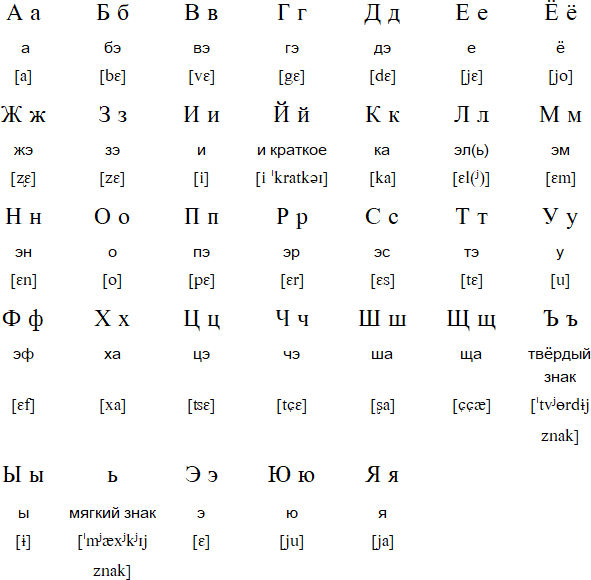
They also learn the Russian alphabet which is also Cyrillic and shares many letters:
Russian alphabet and pronunciation


I know these look almost exactly alike because most of the letters are the same, but the differences are important to Ukrainians.  I immediately recognize the difference when I see an I / i with or without the double dots.  For instance, the church hymn book covers read ГИМНЫ or ГІМНИ.  (In the temple or the chapels we have both Russian and Ukrainian hymn books available.  I prefer Russian since I can read and understand it)


Can you decide which Gospel Principles text is Russian and which is Ukrainian?  Be careful because there is a letter in the Russian alphabet that is Ы (which we often call 61 because it's name/sound is difficult for us to pronounce--it isn't exactly a y sound).  It may look like two characters, but it is one letter.  So it doesn't count as an I / Ї. 


I suppose most people around the world now learn the Latin/Roman/English alphabet.  Modern communication with Internet, television, marketing, make it interesting if not mandatory.   So as we are out and about, we constantly see signs that are written in Ukrainian, Russian, English, or other European languages.  It is a constant mental game of decoding!  For instance, the "Kry" store is the closest place to get groceries in our neighborhood and you see it properly spelled here.  Can you read "supermarket", "disco bar pulse", "bank", "cosmo", and "sport" among the words on the sign?

These are the other stores that are located right across the highway from us, but only accessed by walking down to the underground walkway near  Kraui and than back up the street.  Their signs are easily read.  Novus is a Ukrainian-based company but their sign/logo is written in English ! ?  Praktiker is a building supply store headquartered in Germany so they use Roman letters.


We initially wanted to sound out this store name as "Villa" but then realized that the B was not a Cyrillic letter.  Why?  Because the L's are not Cyrillic.  The Billa company is in Austria.


Annmarie told us that she often shopped at Auchan hypermarket stores in Italy.  Auchan is headquartered in France and is like a super Walmart. The store space also includes many other shops and kiosks.  Notice the Ashan store name is in Cyrillic but the mini-mall sign is easy to read English!  


We walk by this Subaru dealer on our way to the bus stop/underground walkway.  This is so typical of mixing English with Cyrillic.  I'll leave it for you to decode--have fun!


I wanted you to see the Liahona magazines that we have here.  Perhaps you already know that the church now produces the Liahona in many languages and the layout is exactly the same in any month's issue, with the pictures on each page sized to take up the space left after the language, longer or shorter in translation, is put in.  In each Liahona there are sections for children, youth and young adults, incorporating information taken from the Friend and New Era.  Then a center section is added with news and articles from that country/mission.


The bottom right Liahona is in Armenian.  We had some experience with this language as a group of 8 Armenian saints were at the temple the first week in March.  We had the ordinance cards for them in their language and they could hear the Armenian audio in the sessions.  It has a very interesting sound.  But I did not want to try to learn the alphabet.  Bro. Sherwood (a temple missionary who used to live in our Rexburg ward and has a remarkable language ability, having served in Samoa, Hawaii, Spain, Novosibirsk, and here) remarked that the letters looked like a package of broken ramen noodles!  He also bewails that the tower of Babel was ever built with its consequences!  Here are our temple and missionary name tags:


We have at least two other languages in our temple district.  We did have a Romanian couple attend the temple in February.  Thankfully he knew English and several other languages.  She was not as fluent in English.  They listened to the sessions on headphones in their language.  I helped prompt her at the end with a card and had to just follow along pointing where I knew she would be and presuming she was saying things correctly.  The alphabet is Latin/Roman based but with interesting little additions to some of the letters.  Wikipedia said it was closest to Italian!  We haven't had any Bulgarians come to the Kyiv temple yet.  Their alphabet is almost the same as Russian.  We now have white  Books of Mormon in each of the temple languages for patrons to use while in the temple.  

Wednesday, March 2, 2011

Our Own Apartment

Our apartment is on the second floor, the third and fourth windows to the left from the front end corner (not the rear corner) pictured.
  This was taken near the entrance to the apartment.  The telephone and TV jacks on the wall to the left dictate where some things may be placed.  
We turn the upholstered chairs around to face the couch when we are visiting with friends as seen in the following picture.
This picture is taken from the window looking back towards the front door and kitchen.  In the sink is an additional faucet that provides our special filtered water we can drink.  We are very blessed to have this "built in" to our apartment.  The end wall where we have family photos posted is the side of the refrigerator.  It is visible at the right in the following photo with matching cabinet doors so you don't realize that it is the fridge and can't stick things on the door with a magnet!


To the left is a hallway that contains the bathroom sink area with the door to the bedroom at the far left.  The door on the right is to the other bathroom facilities.  Having a new apartment, everything was sparkling clean when we moved in.  We try to keep the glass shower stall unspotted by using a squeegee.  With the radiator next to the shower this room is kept very warm, our towels are dried and warm and there is no problem with mold growing.  The toilets in Europe have different bowl styles.


 Across from the bedroom door just beyond the bathroom facilities to the right we have a large walk-in closet with plenty of space for our things.  You can just barely see the high shelves where our suitcases are stored.  
Finally, there is our bedroom with a king-size bed that we enjoy.  I sleep on the side nearest the door.  It is my personal blessing that when I have my head on my pillow I have the following view of the temple:  first in daylight with the sheer curtains drawn so you can clearly see the temple tower; then at night as the lit tower perfectly fits in the triangle framed by the drapes.  


The temple is lit from dusk until 11p so if I am still awake I see the lights go off by stages--first the bottom main building and the a minute later the tower, leaving only a halo of red lights at the base of Moroni's feet to warn airplanes.  The lights are turned on at 5a but I don't get up that early!  

Tuesday, March 1, 2011

The Patron House--Missionary Accommodations


This is the patron house from the west end where the temple missionaries are housed.  The balcony patio and apartment on the ground floor belongs to the temple president.  They have hosted young single adults they know from a previous CES mission in this area to a hamburger barbecue!  We access the upstairs balcony walking through the missionary lounge that we use weekly for meetings and social gatherings.
Here we are having our Thanksgiving dinner in this same area and all of us temple missionaries and the temple presidency afterwards on the balcony


In the basement is a large area used for many purposes.  In one corner are our exercise bicycle and treadmill.  We are very grateful for this equipment, especially during the cold winter.  There is also enough room for persons to just walk around and do other exercises.
This is the laundry room provided for missionaries only.  Having 5 washers and 5 dryers is wonderful.  We have learned to use them at different times of the week, not just on Monday mornings!  Then we can do all of our many loads of laundry at one time.  The vacuum in the corner serves well to clean our area rugs and can be taken to our apartments to vacuum the vinyl or tile floors.