Saturday, June 9, 2012

Traveling West in Ukraine--Castles


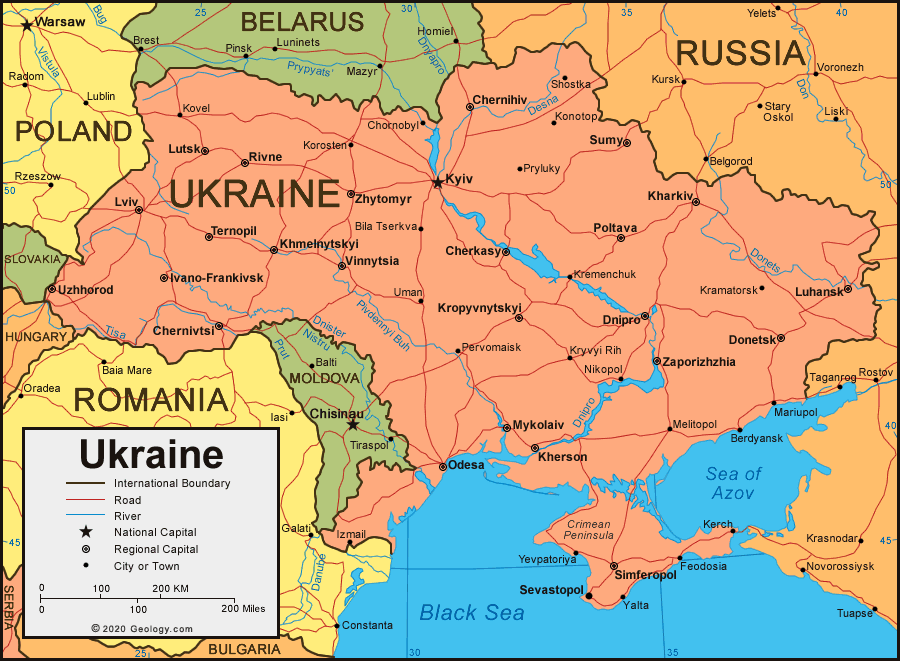
We left Kyiv with Igor Poddubny driving, heading west Friday afternoon, June 1, and needed to be at Rivne by 6:30.  The road was very good, double wide, mostly rebuilt because it is the main highway connecting Warsaw, Poland and Kyiv, Ukraine.  It was just before the Euro 2012 soccer tournament began and it was obvious that crews were finishing up construction that was promised and necessary to the month-long soccer tournament.  We traveled through rolling agricultural land interspersed by forest and rivers.  Ukraine is a very beautiful fertile country.
We stayed the night at the main hotel in downtown Rivne, nicely remodeled and comfortable.
Saturday we drove further west towards L'viv and stopped to see the castle at Oles'ko set nicely on a commanding hill.
We had to wait until the gates were opened and took a few pictures of buildings outside the palace grounds including this Roman Catholic Church and monastery complex.  I have no information about this modern statue outside the walls.
The castle on a steep hill was the site of an ancient Russ fortress from 1347.  It was  destroyed by the Tatars in 1519 and rebuilt in Italian Renaissance style by Ivan Danilowicz with a gateway tower and a lovely park outside the southern walls.   This area of Ukraine was often part of Poland so there was a strong Catholic religious influence.  
Outside at this corner is the entrance to a basement restaurant which has been created in the former dungeon.  You can see the lovely furnishings and one can dress up in period costumes!
These are part of the gardens outside with some older statuary and some newer.  We are standing at the bottom of the stairs that lead down to the garden and embellished with Lions
Here is a buggy for hire!  Olesko was the birthplace of Jan III Sobiesky.  His mother was the daughter of Danilowicz.  This Sobiesky family became owners of Zolochiv, the next castle we visited south and on the road back towards Ternopl'
Though the castle is much smaller, Jan III's father reconstructed, fortified and made this castle an unassailable fortress with bastians as seen here.
Rooms are on two levels with the more public but less restored ones on ground floor
A small private chapel
Upstairs are lovely living spaces.  There were seven lavatories in the palace, unique for that time.
Jan III became a famous Polish king and further constructed this palace for his bride adding the  oriental-looking building, the Chinese Palace and a lovely garden.  
The entrance building is less restored
This lovely Catholic church is outside another palace nearby that we did not visit for lack of time.
The last castle we visited was at Medzhybizh past Khmel'nyts'kyi towards Vinnytsya.  Set at the confluence of 2 rivers a fort was mentioned as early as 1146.  Lithuanian overlords built a fortress in the 1400's and the Tatars failed to conquer during the 1500's.  In the 1700's it became property of the wealthiest Polish princes. 
The castle is under reconstruction and we just stepped inside the gate to take a couple of pictures because it was closing time.
This is outside the far end.

Friday, June 8, 2012

Chapels in the Kyiv Mission

On our recent trip we were able to visit three more chapels.  This small one is in Rivne, west of Kyiv.
This branch building in Odessa is also constructed near the end of an apartment building like the previous one.  Obviously the branch is larger, with a second story and basement available.
This historic building in downtown Odessa was bought by the church.  It is located just a block from the beautiful opera house and is also walking distance to the port with a park nearby.  The shell of the building had to be maintained but the inside was completely remodeled to fit the needs of the large branch.  The ground floor is primarily the chapel
Here is a group of institute graduates and you can see the lovely windows to the back side of the building which is a park on the interior of a city block.  Here is a photo of that outside of building.
You will recognize the dormer windows in this photo of the upper story open lounge area for gatherings. This was the refreshment time after the seminary/institute graduation.  Classrooms on the left for institute/seminary/youth groups and a small kitchen finish out the top story.
The second floor is classrooms including one with family history computers.  The basement has a baptismal font, dressing rooms/restrooms.
In Chernigov, north of Kyiv near the Byelorus border, the branch now meets in part of a building that was a bank.  This is the exterior of the building.
The branch occupies the first floor space.  Windows looking out onto the street are in classrooms. On the back side of the building is the area of the chapel/multi-purpose room.  This was our last Sunday there and the branch always wants to take a picture.
Then there was food and conversation.  The wide tiled hallway provides place for tables of food 
to be set up buffet style.  
These are the children of the branch Primary.  

Thursday, June 7, 2012

Sleeping Beauty Ballet

For our last visit to the Taras Shevchenko Ukrainian National Opera House we enjoyed a production of "Sleeping Beauty" with music by Tchaikovsky and dancing based on the original choreography by Petipas.  We had been at the opera house ticket office just after the tickets went on sale so we were able to get front row balcony seats for 8 of us to enjoy.  Georgia & Sherwood Ricks accompanied us with 2 other couples of the  temple missionaries.
The director of the St. Petersburg Ballet asked Tchaikovsky to compose music for a ballet in 1888. Wikipedia tells us, "Although Tchaikovsky may not have been very eager to compose a new ballet (remembering that the reception of his Swan Lake ballet music, staged eleven seasons earlier, had only been lukewarm), he set to work. The ballet, with Tchaikovsky's music (his Opus 66) and choreography by Marius Petipa, was premiered in the Saint Petersburg Mariinsky Theatre on 24 January 1890.  The ballet has a prologue and 3 acts. Besides being Tchaikovsky's first major success in ballet composition, it set a new standard for what is now called "Classical Ballet", and remained one of the all-time favourites in the whole of the ballet repertoire."


I only snapped a few shots with the camera without flash and thus needed to take the photos when dancers were posing, not moving. Everyone knows the the story of the wicked fairy's curse on the king and queen's baby daughter that the princess will prick her finger on a spindle and die.  Here is Carabosse (slightly moving) with her entourage and the other good fairies in the background.
   Here at her 16th birthday party Aurora is dancing with four would-be suitors.
After Princess Aurora pricks her finger, the good Lilac Fairy weakens the spell so that the princess is only sleeping along with all of the kingdom.
100 years pass and a prince comes into the area to hunt.  The Lilac Fairy shows him a vision of a beautiful girl dancing with nereids.  He even dances with her and then begs the fairy to take him to this mysterious princess. 
The prince kisses Aurora and everyone happily awakes. 
Act 3 is the wedding party of Aurora and the prince.  Of course there are wonderful dances between the prince and princess.
Included in the wedding party are fairy-tale characters who also dance duets (l to r): Princess Florine and Blue Bird, White Kitten and Puss in Boots, Little Red Riding Hood and the Wolf, and Cinderella with her Prince.  
The Lilac Fairy has overcome evil with goodness and blesses everyone in the finale.