
We left Kyiv on the overnight train to Simferapol Monday, Jan 16. I talked to our train car attendant and he showed me the route on the west side of the Dneiper River southeast until crossing over at Dnipropetrovsk, then to Zaporizhzhaya and then south. We could have gone on the train as far as Sebvastopol, but could only rent a car in the capital, Simferopol. We left at 8:20p so we were traveling through the dark of night until morning when we could see some of the farm lands in the south, then the crossing over causeways to the peninsula, arriving after 10a.

There was some snow all the way south! This was our arrival Tuesday morning at 10:20a at the beautiful Simferopol train station.

We took a bus to the airport where we picked up our rental car.

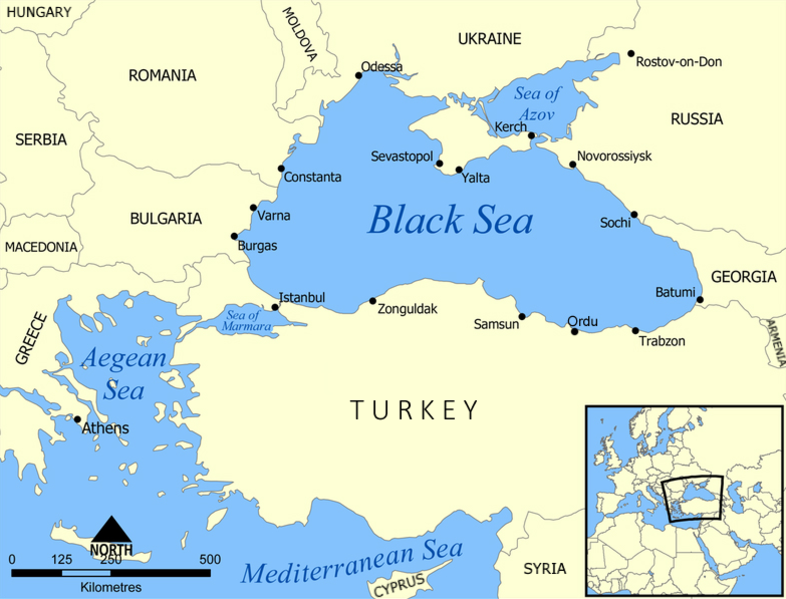
This map will help track our trip around the "golden loop or ring" of Crimea: southwest to Sevastopol, around the southern coast in the greater Yalta area as far as Alushta, and then back up to Simferopol.

For a better idea of how the Crimea has been a key to many trade routes and political conquests, one needs to see the location in the Mediterranean area. [I'm grateful to Wikipedia for the maps]
CHERSONESOS
The earliest established city in Crimea was at Chersonesos by the Greeks in 528 BC who came from a city across and along the south coast of the Black sea (present day Turkey). It is located along the coast at Sevastopol. Eventually several other port cities on the north side of the Black Sea were established. Chersonesos was a big city port, surrounded by walls.


Where the Vladimir Cathedral (obvious in the background) now stands was the city center in Greek and Roman times with porticos and columns.

In the first centuries AD Chersonesos came under Rome
and then later Byzantium rule. Constantine adopted Christianity as his state religion and it was exported all over the Byzantine empire. In 988 AD Vladimir
traveled to Chersonesos to be baptized and married. He then took his religion and
wife to Kyiv and his Kyiv Rus state. All residents of Kyiv were forced to be baptized in the Dnieper!

To commemorate the baptizing of Vladimir, in 1861 in the presence of Alexander II the foundation of this cathedral was laid. It was completed in 1891 and then closed in Soviet times. Blown up by Nazis in 1944, restoration work started in 1999.

Christian traditions, including writings of Eusebius quoting Origon, say the apostle Andrew preached all along the coasts of the Black Sea. Legend has it that he traveled up the Dnieper River and reached the future location of Kyiv in 55 AD, where he erected a cross on the site where the St. Andrew's Church of Kiev currently stands, and prophesied the foundation of a great Christian city, Jerusalem of the Russian land. Upon returning to Asia Minor, he was executed by the Romans by crucifixion being bound (not nailed) on a cross. Supposedly at his request, it was X shaped, not the type used for Christ's death, and that X-shaped cross became known as the St Andrew's cross, used in flags like the Russian navy, and Scotland's national flag!
In middle of 15th century, after several
changes of political control, and 2000 years, Chersonesos ceased to exist! It is the largest site of Greek ruins in Crimea.
BAKHCHISARAI

Because they were Muslims, who often raided the northern mainland capturing people and then selling them off to the Turks as slaves, Tatars were not loved by the Ukrainians/Russians. Under Catherine the Great’s rule, they were not treated well and most moved to Turkey. She then gave away their land to wealthy friends and the Crimea became the sunny vacation spot for Russian nobility. During the 1900’s the Crimea was occupied by various empires, until reverting back to Soviet Russia. Stalin accused Tatars of being disloyal and deported them to work in Uzbekistan, with half dying in the first year. Thus land again came under Soviet control. Sanatoriums were built and vacations were given those whom the Communists wanted to reward. There were, in fact, few other places that Soviet citizens could come for a seaside holiday, as foreign travel was forbidden to all but a handful. After the fall of the USSR, Crimea became an autonomous republic in Ukraine. Bakhchisarai is the heart of Tatar repatriation.
Nearby and up the canyon are are an old Orthodox monastery and across the canyon a city of Karaite Jews. They are built in natural caves in the weathered limestone. We did not hike up to these areas and the photos are from Google. It is interesting that the Muslims, Jews, and Orthodox Christians all respected one another. Crimea takes its name from the capital city of Golden Horde time meaning "my hill".


