Monday, January 23, 2012

The Crimea


We left Kyiv on the overnight train to Simferapol Monday, Jan 16.  I talked to our train car attendant and he showed me the route on the west side of the Dneiper River southeast until crossing over at Dnipropetrovsk, then to Zaporizhzhaya and then south.  We could have gone on the train as far as Sebvastopol, but could only rent a car in the capital, Simferopol.  We left at 8:20p so we were traveling through the dark of night until morning when we could see some of the farm lands in the south, then the crossing over causeways to the peninsula, arriving after 10a.  
There was some snow all the way south!  This was our arrival Tuesday morning at 10:20a at the beautiful Simferopol train station.
We took a bus to the airport where we picked up our rental car.
This map will help track our trip around the "golden loop or ring" of Crimea: southwest to Sevastopol, around the southern coast in the greater Yalta area as far as Alushta, and then back up to Simferopol.
For a better idea of how the Crimea has been a key to many trade routes and political conquests, one needs to see the location in the Mediterranean area. [I'm grateful to Wikipedia for the maps]
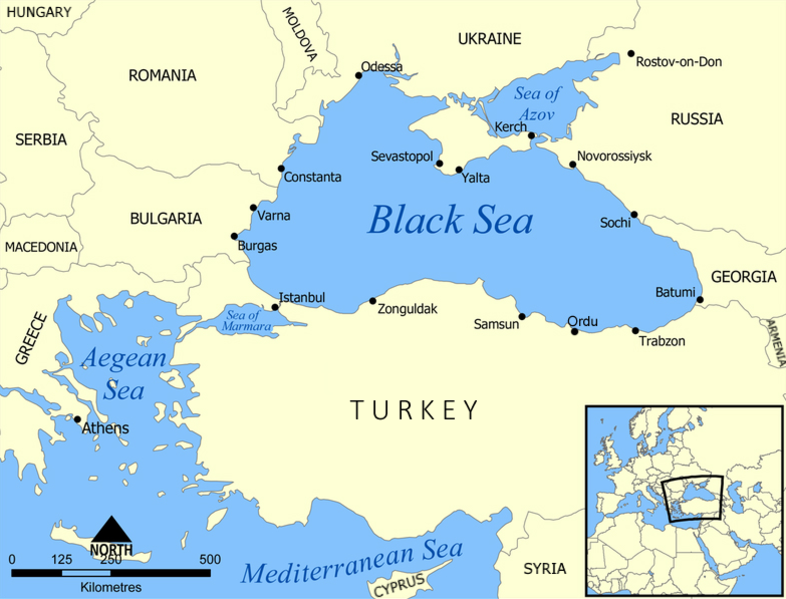
 File:Black Sea map.png
CHERSONESOS
The earliest established city in Crimea was at Chersonesos by the Greeks in 528 BC who came from a city across and along the south coast of the Black sea (present day Turkey). It is located along the coast at Sevastopol.  Eventually several other port cities on the north side of the Black Sea were established.  Chersonesos was a big city port, surrounded by walls.
 Where the Vladimir Cathedral (obvious in the background) now stands was the city center in Greek and Roman times with porticos and columns. 
In the first centuries AD Chersonesos came under Rome and then later Byzantium rule.  Constantine adopted Christianity as his state religion and it was exported all over the Byzantine empire. In 988 AD Vladimir traveled to Chersonesos to be baptized and married. He then took his religion and wife to Kyiv and his Kyiv Rus state.  All residents of Kyiv were forced to be baptized in the Dnieper! 
To commemorate the baptizing of Vladimir, in 1861 in the presence of Alexander II the foundation of this cathedral was laid.  It was completed in 1891 and then closed in Soviet times.  Blown up by Nazis in 1944, restoration work started in 1999.   
Christian traditions, including writings of Eusebius quoting Origon, say the apostle Andrew preached all along the coasts of the Black Sea.  Legend has it that he traveled up the Dnieper River and reached the future location of Kyiv in 55 AD, where he erected a cross on the site where the St. Andrew's Church of Kiev currently stands, and prophesied the foundation of a great Christian city, Jerusalem of the Russian land.  Upon returning to Asia Minor, he was executed by the Romans by crucifixion being bound (not nailed) on a cross.  Supposedly at his request, it was X shaped, not the type used for Christ's death, and that X-shaped cross became known as the St Andrew's cross, used in flags like the Russian navy, and Scotland's national flag!  
In middle of 15th century, after several changes of political control, and 2000 years, Chersonesos ceased to exist!  It is the largest site of Greek ruins in Crimea.   

BAKHCHISARAI
The area of Crimea was conquered and controlled by many different ethnic groups.  In the 1200's the Mongols came and were succeeded by the Golden Horde.  As many of these people settled instead of being nomads, mixed with the other ethnic groups, especially Turkic peoples, and the Golden Horde was defeated, the Crimean Tatars became a people and founded an independant Khanate.  They had close relations and eventually were submissive to the Ottoman Empire.  They adopted Islam in the 13th century.  Bakchisarai was established as the capital with the building of the Khan's Palace in 1551.  It was added to over 200 years by succeeding Khans and many mosques were also built.  We were not able to go inside the complex of buildings because it was closed for cleaning (except for a tour group that arrived after us and got in!)  So I have added some images from Google after this one we took of the "workers" outside the gate!  

Because they were Muslims, who often raided the northern mainland capturing people and then selling them off to the Turks as slaves, Tatars were not loved by the Ukrainians/Russians. Under Catherine the Great’s rule, they were not treated well and most moved to Turkey.  She then gave away their land to wealthy friends and the Crimea became the sunny vacation spot for Russian nobility.  During the 1900’s the Crimea was occupied by various empires, until reverting back to Soviet Russia.  Stalin accused Tatars of being disloyal and deported them to work in Uzbekistan, with half dying in the first year.  Thus land again came under Soviet control.  Sanatoriums were built and vacations were given those whom the Communists wanted to reward. There were, in fact, few other places that Soviet citizens could come for a seaside holiday, as foreign travel was forbidden to all but a handful.  After the fall of the USSR, Crimea became an autonomous republic in Ukraine.  Bakhchisarai is the heart of Tatar repatriation.


Nearby and up the canyon are are an old Orthodox monastery and across the canyon a city of Karaite Jews.  They are built in natural caves in the weathered limestone.  We did not hike up to these areas and the photos are from Google.  It is interesting that the Muslims, Jews, and Orthodox Christians all respected one another.  Crimea takes its name from the capital city of Golden Horde time meaning "my hill".
Ancient cave city Chufut-Kale - Древний пещерный город Чуфут-Кале


Wednesday, December 28, 2011

The Perfect Christmas Holiday Season

For missionaries away from home, holidays can be melancholy times.  As our cabin was being readied and family members were arriving a week in advance from out of town, we thought of them and wished we could be there.  Getting our Christmas letter/blog prepared was good therapy and kept me busy most of the week.  We also were beginning to exchange gifts with temple missionaries and workers.  Small sincere presents given and received helped focus on what we enjoy here and not what we were missing.


We knew in advance that Christmas Eve on Saturday would be a regular day at the temple.  December 24/25 are not holidays in Ukraine but some of our good members came to the temple because they wanted to remember Christ in a special way.  When we got home we had preparations for the next day to make.  And we received a special gift of a small lighted Christmas tree that made us happy!
Sunday morning was clear, cold and dark as we left Kyiv.  We were able to be passengers in a car driven by temple patrons from Moscow who were returning home by way of Smolensk.  So driving north through Chernigov was “on the way” and a place to stop for church services.
It was nice to be able to take our extra sacks of baked goods and food for the dinner in their car and not on the public transportation we usually use.  
It was a frosty morning and there had been fog at night that had frozen onto the trees.  We were able to take some beautiful pictures as the sun was rising.  
As we drove farther north and near the Desna River, the frost on the trees got thicker!
This is the usual sight of St. Catherine's church (1715) as we enter Chernigov, but dressed up in frost!  In the park across the street from our current meeting location is a very old church (built around 1201, damaged and restored after WWII).  I hurried to take a picture in the morning sun.
  
We arrived early and I could sing with other sisters around the key board as we often do.  As we were singing Christmas carols I felt deeply how “perfect” this Christmas was! 
The speakers in the sacrament service were a convert of a year using information from the Ensign on the history of celebrating Christmas, the branch president’s counselor giving a testimony of Christ, and then the branch president.  Since Christmas is celebrated here on Dec 25 or Jan 7 and there is gift giving also on several other days, the holiday season is prolonged for almost a month.  He made the point that it doesn’t matter when we celebrate; it is better to just think of Jesus and giving gifts daily.  He ended his talk with the Savior’s invitation, “Come, follow me”.  Then we all prepared to serve the food that everyone had brought and had a feast. 
This is the serving table before it was completely covered with food for people to eat!
The children were careful to select the most important foods!
As we walked to the bus stop, we went through the city square where the New Year's tree is located.  Amusement rides had been brought in and some of them were operating even though it was a week before the New Year holiday.
We arrived back at our temple block with the display of the first Christmas
In the afternoon we had time to Skype with all of our family members as they were beginning their Christmas mornings opening presents before attending church.  We were also grateful for iPhone pictures.  Here are two examples:
They got up earlier than 7a but could not wait!
They had church early at 8a!  Good job getting ready early

Our Christmas celebration continued through our Monday when we had a wonderful turkey dinner with our temple missionaries.  Unfortunately I was too busy enjoying the good food that everyone helped prepare to think about taking pictures until we were clearing things away and preparing for our program.
JD was part of a reader's presentation
We sang carols and shared spiritual thoughts.  Half of our group leaves this January, so we especially enjoyed this time together.  
We also had a temple missionary social on New Year's Eve, after another week including Saturday at the temple.  There was more good food!
And we played some games--here trying to be serious and not smile or laugh, and later a few rounds of Rook for those few who were interested.  We stayed up until midnight, and then went to sleep listening to many fireworks being set off all around and most of the night.
Sunday morning, New Year's Day, we walked to attend church in a ward about a mile away, passing by a beautiful Orthodox building glistening in the morning sunlight.
Our church meeting place is much less impressive--the second floor of a commercial business building, with the entrance door open on the right end.  But we enjoyed meeting with the members.  Then we walked home and had the rest of the day to relax and communicate with family.  The Orthodox Christmas Day is Jan 7 with New Year's Day following on Jan14, so there are holidays ahead.  We will have patrons visiting the temple because school is out and some have vacation from work.  So we will enjoy our time in the temple.


Friday, December 23, 2011

Don't Forget the Star!


Don't Forget the Star is the title of a short book by George Durrant that JD read to our children as they lay in the cabin loft bedroom trying to go to sleep on Christmas Eve.  The younger girls dropped off to sleep during the early chapters about Durrant's childhood memories and the older boys sometimes lasted through the later chapters describing missionaries away from home during the holidays.  The children could look through the bedroom door and see the star that topped our tall Christmas tree.


Here in Ukraine, trees are being erected in town squares but they are New Year's trees.  I have recently been reading Babi Yar by A Anatoli Kuznetsov, who recounts what it was like to live in Kiev, specifically from the time that the Germans occupied until their withdrawal (Sept 21, 1941—Nov 4, 1943) and the reoccupation of the Soviets.  Of his earlier life, he wrote: 
I began going to school ...in 1937…at the age of eight.   The papers announced that an outstanding comrade-in-arms of Stalin’s, Postushev, had proposed the introduction of a new national holiday-the New Year, complete with a fir tree.  Until then, ever since the revolution, there had been no fir trees, so that for us small children this was really something new.  The fir tree was set up in the new school building, the little girls dressed themselves up as snowflakes, and I recited a poem about Jack Frost surveying his domains.  And we finished up with a song which had appeared in the newspaper and which ended with the words:  “And it was Mr Postushev who gave us our lovely tree.”
Grandma said: ‘This is Christmas. It was Jesus who gave us the tree.”  I argued with her: “No, it was Postyshev.  There is no Jesus Christ and there never was!  Soviet rule gave the children fir trees.”  “You little puppy,” Grandma said, and we had a violent quarrel.  But my mother said: “My goodness, what a lucky boy you are, Tolya.  You’ve only just started school, and they’ve built you a new school,… introduced the fir tree again, and even asphalted the footpaths.  All you have to do is work.  Make the best of it all and work hard; only read more, read everything you can---there is wisdom in books.”
It soon became apparent, however, that not everything in the books was wisdom.  In class one day we were ordered to open our textbooks at the page with a portrait of Postushev on it and tear it out---Postushev had turned out to be an enemy of the people.   So he was executed, even though he had introduced the fir tree.  It was a big shock for our little minds, but we weren’t given a chance to think much about it.  It immediately became a matter of routine, something quite ordinary and usual.  Sometimes we would be ordered to tear out other pages, on other occasions to cross out with ink certain sentences or names.  Making a mess of our textbooks was really quite a pleasant occupation which we all liked enormously. 
This is the city plaza (named Red Square) in Chernigov with the New Year tree just erected.
Wikipedia gives the following information about Christmas trees:
The custom of erecting a decorated Christmas tree can be historically traced back at least as far as 15th century Livonia (Estonia) and 16th century Northern Germany.…  Only in the 19th century did they come into use more widely, often in schools and inns before they appeared in homes…. In the early 19th century, the custom became popular among the nobility and spread to royal courts as far as Russia…  In Russia, the Christmas tree was banned shortly after the October Revolution but then reinstated as a New-year fir-tree (Новогодняя ёлка) in 1935…. It became a fully secular icon of the New Year holiday; for example, the crowning star was regarded not as a symbol of the Bethlehem Star, but as the Red Star….  This tradition persists after the fall of the USSR, with the New Year holiday outweighing the Christmas (7 January) for a wide majority of Russian people.

A fellow temple missionary couple, the Terry's, who served as English teachers in China, told us that "Christmas" with trees and presents and Santa is celebrated widely in China, but with no attachment to Christ.  They don't even know what the word Christmas means.  As we see large displays of tree ornaments and holiday decorations here in Ukraine, they are the same as can be bought in America, and probably throughout the world and they are mostly made in China!  The holiday has become popularized and commercialized worldwide as a reason to sell things and have a vacation.  

Wherever there are good practicing Christians we will all try to keep Christ in Christmas---"Don't forget the star"!  In our patron house lobby a decorated tree was set up for the first time this year.  This is a young family from Odessa who have spent the week before Dec. 25 in Kyiv near the temple, making memories with their young ones.  These children are being taught about Jesus and Christmas.   
While we don't have a large tree in our apartment, or many presents, we have everything we really need.  We are grateful for the best gifts: for loving family members, for this special opportunity to be serving in Ukraine, and for our Savior, who is the center of this Christmas holiday, and our lives.  Because of Jesus Christ, all people will be resurrected and live forever.  Through acceptance of Christ's atoning sacrifice, people will not need to suffer for their sins and can again live in His presence.  If we make and keep sacred covenants in holy temples, our families can continue to be together eternally and we can be part of Heavenly Father's kingdom.  These are the greatest gifts from Heavenly Father and Jesus Christ to all mankind.  Thus we try to remember and always follow the star that first lighted the way to the baby Jesus in Bethlehem:

What shall we give to the babe in the manger,

What shall we offer the child in the stall?

Incense and spices and gold we've a-plenty-

Are these the gifts for the king of us all?

What shall we give to the boy in the temple,

What shall we offer the man by the sea?

Palms at his feet and hosannas uprising;

Are these for him who will carry the tree?

What shall we give to the lamb who was offered,
Rising the third day and shedding his love?

Tears for his mercy we'll weep at the manger,


Sunday, November 6, 2011

National Chorus of Bandura Players of Ukraine

On November 2 we attnded a concert in the lovely National Philharmonia Hall of Columns.
We had front row balcony seats and could take pictures without flash.  

The following comes from the group's website:

National Honored Chorus of Bandura-Players of Ukraine named after H.I.Mayboroda is a male vocal-instrumental ensemble that accompanies its singing with the playing of the multi-stringed Ukrainian folk instrument known as the bandura.  The group was initially known as the Kobzar Choir and was established in August 1918.  The bandura is a peculiarly Ukrainian instrument. Actually, it is no longer just an instrument, but an embodiment and a symbol of the soul and word of a Ukrainian.

From another website:
The Chorus’ history rapidly evolved into a turbulent one.  The ideals of the bandurist - God, truth, freedom, and human dignity heralded through song - were a threat to the then-newly formed Soviet Union.  Under Joseph Stalin’s rule, artists and intellectuals were arrested, exiled or executed in an attempt to eradicate every remnant of Ukrainian culture.  In the years that followed the Chorus was exploited and persecuted by both the Soviets and the Nazis. 
(After WWII many of the Chorus’ members emigrated from refugee camps to the United States.   Eventually the Ukrainian Bandurist Chorus was formed in Detroit!  In googling, this US group was often the one that came up!)


The Bandura Chous in Kyiv continued, under duress, until Ukrainian independence.  Now they give concerts and travel and are the National Honored Chorus of Ukraine!


I loved the costumes and the look of the members.  The program began with an impassioned  reading by this man.  Unfortunately for us everything was in Ukrainian, so we didn't understand.  Sis Serdyuk, who introduced us to the bandura, made us aware of this concert and helped get us tickets, told us all of songs were "heroic" in nature.  
 
This duo looked and sounded great. The person on the right is a friend of Sis. Serduk.
Besides those playing their banduras and singing, there were also some additional instrumentalists.  They had been sitting to the right, but here they were showcased in several instrumental pieces.
I captured a few selections as video.  Hope you enjoy them.  (The audio is better than the video quality) 


Wheelchairs

On Saturday, October 29, 2011 the humanitarian missionaries were busy finishing a project of distributing wheelchairs in Ukraine.  This is the logo in Cyrillic and English.
Hundreds of wheelchairs of different sizes and styles were shipped to Ukraine and distributed in western L'viv, in southern Crimea, and in Kyiv.  LDS Charities work with local non-governmental organizations (NGO's).  Here are some people being fitted for their own wheelchairs.
During this final distribution point in Kyiv (in the chapel next door) many government dignitaries came to a luncheon and to see the giveaway.
These are some of the volunteers who were trained to help in fitting the chairs and servicing them in the future.  
Many people drove away very blessed by what they had received.
This project was overseen by Bro & Sis Spencer from Utah, who are friends and coworkers with Dan & Kathy Mills, who also serve in these wheelchair projects all over the world for LDS Charities.
 Donations to the church humanitarian fund pay for these chairs.  What a wonderful gift to a person.  And the name of the church is on the back--great advertising!